
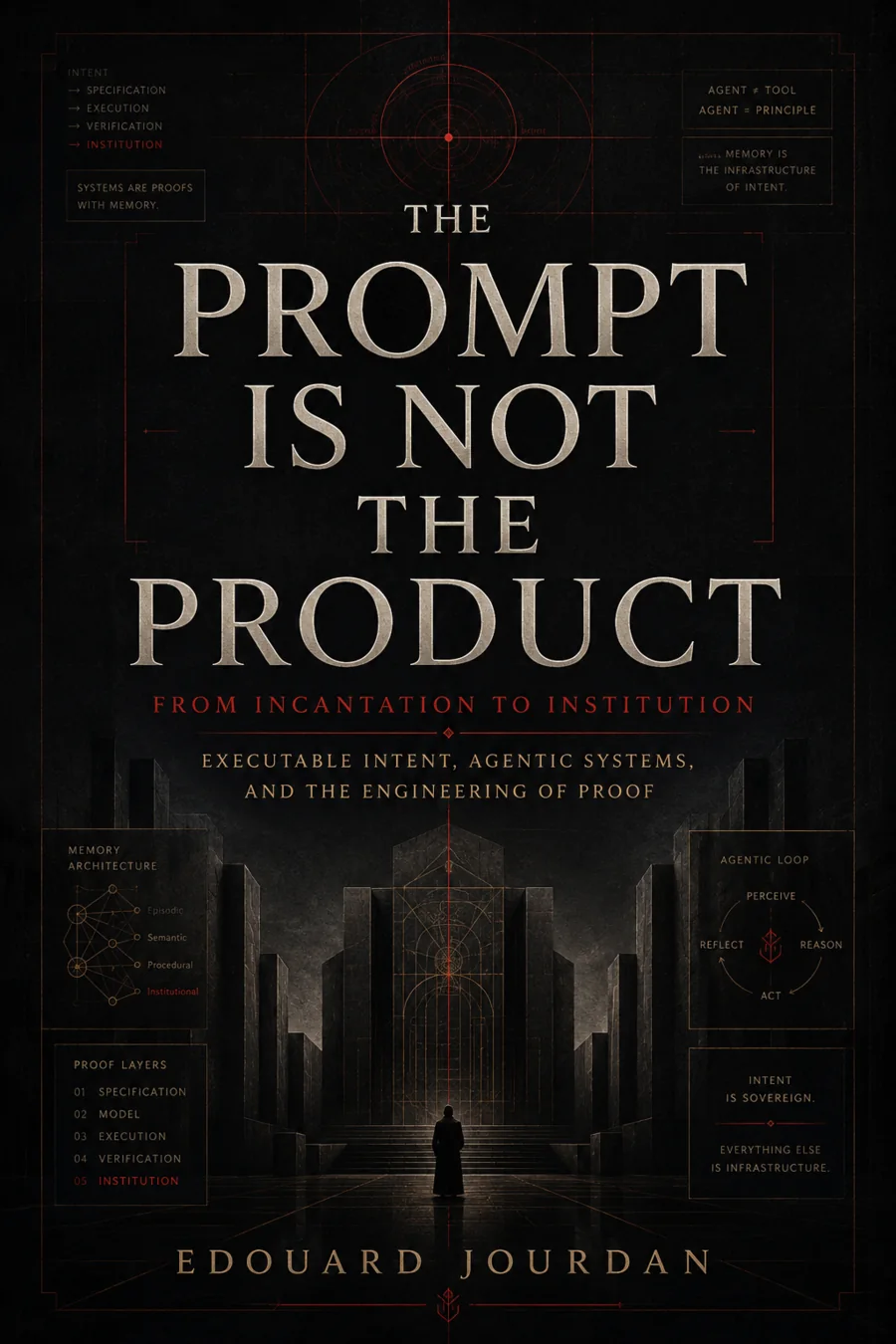
A prompt is an input. It is typed, consumed, and it leaves nothing behind. What endures is the structure that receives it: the specification that constrains it, the memory that carries it, the execution it authorises, the verification that can stop it, and the institution that outlives the session in which it was written.
The five proof layers
The spine of the book, and the order in which it argues.
Incantation is not engineering
A sentence that produced a good result once is an anecdote. The book begins by refusing the trade in which that anecdote is sold as a deliverable: work that cannot be repeated, cannot be audited and cannot be defended on the day it fails is not a product, whatever it cost to obtain.
Memory is the infrastructure of intent
Intent that cannot be recalled is intent that must be retyped, and intent retyped is intent quietly rewritten. Memory is treated here as load-bearing structure rather than convenience: what the system knows, where the knowledge came from, when it was last true, and what happens to a decision once its evidence has expired.
An agent is a principle, not a tool
A tool is called; an agent is entrusted. The distinction is not vocabulary, it is liability. The book sets out bounded autonomy as something written down where a machine can enforce it, rather than as a tone of voice adopted in a system prompt.
Proof, or no action
Verification is not a phase at the end. It is the condition under which a system is permitted to act at all. The most valuable capability a production system has is the right to refuse — and to say why, in a form a human can read and a machine can replay.
What survives the run
Institution is the last layer because it is the only one measured in years. A system becomes durable when its contracts, its evidence and its refusals outlast the session that produced them.
The doctrine this site is written under
Every dossier here states a verified state and a list of stated limits, and none of them implies a release that a human has not signed. That discipline is not a house style. It is this book, applied to its own author’s work.